- Home
- Foot & Ankle Conditions
- Sports Injuries
- Foot Bursitis
Foot Bursitis
- Published 11/1/2023
- Last Reviewed 3/28/2024
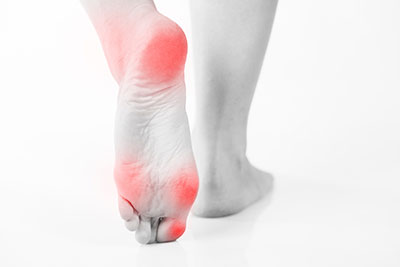
What is foot bursitis?
Bursitis can occur in nearly any joint when the bursa sac becomes swollen with fluid and inflamed. Bursae are small, slippery, fluid-filled sacs, much like tiny water balloons, that act like a cushion over a joint to decrease friction. They also act as a lubricant between the bones, muscles, ligaments, and tendons of the joint.
Each bursa sac consists of a thin-walled membrane (called the synovial membrane or synovium) and the synovial fluid produced by the membrane. There are a few different bursae within the feet that can develop bursitis due to overuse, injury, bone deformity, or medical conditions (such as arthritis).
What are the types of bursitis in the foot?
Because there are multiple bursae in the foot, there are multiple places bursitis can develop.
- Back of the heel: The retrocalcaneal bursa is located in the back of your heel bone (calcaneus) and reduces the friction and pressure from your heel bone on your Achilles tendon when you’re standing. Inflammation of this bursa is known as retrocalcaneal bursitis. It’s often caused by tight shoes that dig into the back of your heel.
- Bottom of your heel: The sub-calcaneal bursa is located between the heel bone and the plantar fascia (the thick ligament connecting your heel to the front of your foot). Sub-calcaneal bursa symptoms are often very similar to plantar fasciitis.
- On a toe: There are also bursae sacs in the forefoot near the metatarsal heads of your toes. When a bunion forms on the big toe joint, it puts extra strain on the bursa, resulting in bursitis.
What are the symptoms of bursitis in the foot?
Common symptoms of foot bursitis can include:
- Pain with movement of the joint (such as when walking or standing on tiptoes)
- Swelling and redness around the joint
- Stiffness and limited range of motion
- Affected area is warm to the touch
What causes bursitis in the foot?
More often than not, foot bursitis is caused by overuse, which is common with repetitive impact sports. Certain factors, like engaging in these activities on hard surfaces or being overweight, can exacerbate the issue. However, in some cases, bursitis may be caused by acute trauma to the joint.
Other causes of bursitis in the foot can include:
- Wearing ill-fitting shoes or shoes not appropriate for a particular sport or activity level
- Repetitive running, jumping, or other ballistic movements
- Walking in high heels for prolonged periods
- Failing to warm up and stretch your calf muscles and Achilles tendon before exercising
- Foot deformities such as Haglund’s deformity, bunions, or hammer toes
- Underlying medical conditions like rheumatoid arthritis, gout, diabetes, or thyroid disorders
How is foot bursitis diagnosed?
There are many possible causes of heel pain, so seeing a trained and trusted podiatrist is a must to ensure you’re getting a proper diagnosis and treating the correct problem. The podiatrists at University Foot & Ankle Institute (UFAI) will start with a physical examination of your foot, a history of your symptoms, and questions about your activity level.
A detailed medical history allows us to look for other medical problems that could be causing your pain. We also have access to imaging technology such as X-rays, MRI, and CT-scans that allow us to view the bones and surrounding soft tissues of your foot and ankle. With this information, we can rule out bone fractures, tendonitis, and issues of other parts of the foot that could be impacting your heel.
How to treat bursitis of the foot
At UFAI, we choose conservative treatment options whenever possible. Luckily, most cases of foot bursitis respond well to conservative treatment.
Some treatments we might recommend include:
- Rest. If you are experiencing a lot of pain, it’s wise to stop running or doing whatever activity is causing your joint to hurt. Rest allows your bursa to heal and avoids worsening the problem. You may require two or more weeks of rest.
- Ice and elevation. Icing and elevation of the foot might be recommended during the early stages of your treatment to reduce inflammation and pain.
- Medication. Over-the-counter nonsteroidal anti-inflammatory drugs (NSAIDs) such as naproxen or ibuprofen can help reduce bursitis foot pain and swelling.
- Proper fitting shoes.
When to see a doctor for foot bursitis
If the pain is too intense, gets in the way of your daily activities, or refuses to go away, then it may be time to see a podiatrist or foot specialist. Other warning signs include:
- If the foot feels burning hot
- If you can’t move the foot at all
- If you feel needles or sharp, lancing pain around the joint
- If a lump or bulge appears around the painful joint
Our doctor will need an accurate diagnosis. Usually, this requires a set of X-rays, but we need to see exactly which joint is inflamed and how much. This will also help us rule out similar conditions, such as hairline metatarsal fractures, fasciitis, or tendonitis.
If it looks like you have an infection, we may also need a blood test or a fluid sample from inside the bursa. Again, this is very rare, as most cases of bursitis come from overuse.
If you need quick and intense pain relief, we can also use stronger steroids or cortisone injections directly into the affected joint.
Injections act faster than oral anti-inflammatory medications, but they also increase the risk of infection, so they’re only a stop-gap measure. To make sure bursitis doesn’t return, shots are usually followed by a combination of physical therapy, a splint, or custom-made orthotics.
In rare instances in which folks fail to improve with conservative treatment, a cortisone injection into the heel might be recommended. However, this step is taken only after careful consideration because cortisone has known side effects.
For those extremely rare patients who remain symptomatic after six months, surgery might be indicated. Generally, our doctors will make a small incision to access the problematic bursa. Then, they can drain the bursa of fluid and allow it to heal. If the bursa is damaged, they may need to remove the sac entirely.
How can you prevent foot bursitis?
There are several ways to prevent bursitis pain from starting or returning. Proper foot care to prevent bursitis includes:
- Footwear. Your shoes are one of the most common causes of bursitis, making well-fitting shoes imperative. Athletic shoes should be comfortable and provide adequate support and cushioning to your heel area. Also important is to make sure that the heels aren’t worn down.
- Padded socks. Padded socks will go a long way toward protecting your feet and preventing bursae from forming.
- Stretching. Invest adequate time in stretching your calf muscles and Achilles tendon before all exercise or sports activities.
- Reduce time spent barefoot. Avoid going barefoot on hard, rocky, or uneven surfaces.
- Adjust your treadmill. If you’re a treadmill user, make sure to vary the incline to reduce stress on your heels.
- Manage weight. You’d be surprised by how maintaining a healthy weight can lessen the stress on your heels, not to mention other affected joints, like your knees and hips.
-
Mix up your workouts. Bursitis stems from repetitive motion. Try switching up your workouts by incorporating different movements.
Why UFAI is the best choice for treating foot bursitis
When you choose the University Foot and Ankle Institute, you can rest assured that you have chosen a compassionate team of podiatry experts with decades of combined experience. Our team of physicians uses state-of-the-art equipment to offer the latest diagnostic and curative treatments available and enjoy the highest success rates in the nation.
To schedule a consultation, please call (855) 872-5249 or make an appointment now.
University Foot and Ankle Institute is conveniently located throughout Southern California and the Los Angeles area. Our foot doctors are available at locations in or near Santa Monica, Beverly Hills, West Los Angeles, Manhattan Beach, Northridge, Downtown Los Angeles, Westlake Village, Santa Barbara, and Valencia.

Foot bursitis FAQs
What are the three symptoms of bursitis?
The three most common symptoms of bursitis are swelling, pain, and tenderness of the affected joint.
Will bursitis go away on its own?
With conservative measures, like rest and ice, bursitis may be able to go away on its own. However, if symptoms don’t improve, you may need to seek professional medical care.
Heel bursitis vs Achilles tendonitis, how can you tell the difference?
Achilles tendonitis pain tends to present near the top of the Achilles tendon, more in line with the ankle bone but above the heel. Alternatively, heel bursitis is felt at the base of the heel, a couple of inches below where Achilles tendonitis pain usually presents.
 If you are lucky enough to have Dr. Redkar taking care of your feet problems, you can count your blessings. She knows her job a...Warren M.
 I liked it.Liisa L.
- I depend on the doctors at UFAI to provide cutting edge treatments. Twice, I have traveled from Tucson, Arizona to get the car...Jean S.
- They helped me in an emergency situation. Will go in for consultation with a Dr H????
Re foot durgeryYvonne S.  It's been years finally moving forward getting my bunions and hammer toes corrected surgery went well now in the recovery proc...Mark A.
- It went very smoothly.Maria S.
- My experience at the clinic was wonderful. Everybody was super nice and basically on time. Love Dr. Bavarian and also love the ...Lynn B.
- I fill I got the best service there is thank youJames G.
- Dr Avanti Redkar is the most caring podiatrist I've ever been treated by.....
She gently takes care of ingrown nails and trims ...Lori D. - My experience with your practice far exceeded any of my expectations! The staff was always friendly, positive and informative. ...Christy M.
- Love Dr. Johnson.Emily C.
- I am a new patient and felt very comfortable from the moment I arrived to the end of my visit/appointment.Timothy L.
-
 Listen Now
Swollen Feet During Pregnancy
Read More
Listen Now
Swollen Feet During Pregnancy
Read More
-
 Non-Surgical Treatment for Plantar Fasciitis – What Are Your Options?
Read More
Non-Surgical Treatment for Plantar Fasciitis – What Are Your Options?
Read More
-
 Listen Now
Moore Balance Brace: Enhance Stability and Prevent Falls for Better Mobility
Read More
Listen Now
Moore Balance Brace: Enhance Stability and Prevent Falls for Better Mobility
Read More
-
 Listen Now
Is Bunion Surgery Covered By Insurance?
Read More
Listen Now
Is Bunion Surgery Covered By Insurance?
Read More
-
 Listen Now
15 Summer Foot Care Tips to Put Your Best Feet Forward
Read More
Listen Now
15 Summer Foot Care Tips to Put Your Best Feet Forward
Read More
-
 Bunion Surgery for Athletes: Can We Make It Less Disruptive?
Read More
Bunion Surgery for Athletes: Can We Make It Less Disruptive?
Read More
-
 What To Do When Your Toenail Is Falling Off
Read More
What To Do When Your Toenail Is Falling Off
Read More
-
 Should I See a Podiatrist or Orthopedist for Foot Pain and Ankle Problems?
Read More
Should I See a Podiatrist or Orthopedist for Foot Pain and Ankle Problems?
Read More
-
 Do Blood Pressure Medicines Cause Foot Pain?
Read More
Do Blood Pressure Medicines Cause Foot Pain?
Read More
-
 Listen Now
Bunion Surgery for Seniors: What You Need to Know
Read More
Listen Now
Bunion Surgery for Seniors: What You Need to Know
Read More
-
 Listen Now
What Are Shin Splints?
Read More
Listen Now
What Are Shin Splints?
Read More
-
 Top 10 Non-Surgical Treatments for Morton's Neuroma
Read More
Top 10 Non-Surgical Treatments for Morton's Neuroma
Read More
-
 Listen Now
How To Tell If You Have Wide Feet
Read More
Listen Now
How To Tell If You Have Wide Feet
Read More
-
 How Many Steps Do I Need A Day?
Read More
How Many Steps Do I Need A Day?
Read More
-
 Pediatric Bunion Surgery
Read More
Pediatric Bunion Surgery
Read More


